


Connecting Communities across the Triangle
Now serving more than 232,000 Nextdoor Neighbors in the heart of North Carolina
"BRINGING THE BEST OF NORTH CAROLINA TO YOUR FRONT DOOR"

THE AQUATIC CONSERVATION LABORATORY
AT HISTORIC YATES MILL COUNTY PARK

THE ENVIRONMENT JUST GOT A LITTLE MORE HOSPITABLE FOR ENDANGERED AQUATIC SPECIES IN NORTH CAROLINA — LIKE THE MAGNIFICENT RAMSHORN SNAIL, CAROLINA MADTOM FISH, AND DWARF WEDGEMUSSEL.

Left to right
Greg Cope, Jared Gray,
Chris Eads, Sean Buczek

Dr William Gregory Cope is a William Neal Reynolds Distinguished Professor of Applied Ecology & Environmental Toxicology at NCSU. Jared Gray is the aquatic team lead in the NCDOT’s Biological Surveys Group. Chris Eads is a staff member in Applied Ecology at NCSU and Assistant Director for Facility Operations at the Yates Mill Aquatic Conservation Laboratory. Sean Buczek is a staff member in Applied Ecology at NCSU and Assistant Director for Research at the Yates Mill Aquatic Conservation Laboratory.
Aaron Ellis is the Project and Finance Coordinator for the Carolina Wetlands Association, where she leads the Volunteer Wetland Monitoring Program. Aaron has spent more than 20 years in engineering and environmental project administration across government and private sectors. A 14-year veteran of the U.S. Coast Guard and Reserve, Aaron managed procurement, finance, and logistics for critical military operations. Her diverse background also includes project management, permitting, and conservation efforts spanning sustainable agriculture, landscape design, and artisanal production.
I am glad to be able to help tell the story about all that you are doing to help protect and sustain our state’s endangered aquatic species. One of the valuable benefits that healthy wetlands provide are critical habitants for many of our aquatic species, and your efforts in this respect are much appreciated by all of us at the Carolina Wetlands Association.
We know this project could not have become reality without the assistance of the NC Department of Transportation, but I wish to talk with the research team from NC State first. To begin with, can you tell us why Yates Mill Pond was selected as the location for your aquatic species propagation facility?
I think that perhaps the most important factor in the site selection process was the awareness that captive freshwater mussels benefit greatly from having a wild water source. Reservoirs can be a great resource for wild water because they produce algae and other food items that are highly beneficial for the growth of mussels.
Yates Mill Pond was evaluated by researchers at N.C. State University (NCSU) in this respect, using three different mussel species and was demonstrated to be among the top locations for mussel survival and growth in our area.

Pond at Yates Mill
Were there any other factors used in the search for a suitable location?

Actually, there were.
It was also determined that there already was a suitable infrastructure and research wing at Yates Mill Pond for this project. And NC State already had a research wing at Yates Mill Pond that was being underutilized.
Aquatic Species Propagation Lab
We understand that there were six separate threatened and endangered species that were identified as being suitable for this study. What are they?
Three of the six priority species we are focused on here are endemic to our state – the Magnificent Ramshorn, Carolina Madtom, and Neuse River Waterdog. These three are really neat animals found nowhere else in the world, and we should all be proud to claim them as our unique natural treasures.
While the Yellow Lance, the Dwarf Wedgemussel,
and the Atlantic Pigtoe are native to North Carolina,
they also occur outside of our state.

Carolina Madtom Photo by Craig Lawson
We believe that the fate of these animals is in our hands and that they all have intrinsic value as living, breathing animals that we share the earth with. And they are part of the interconnected ecosystems that we all depend on.
What do you mean when you say that these are part of the interconnected ecosystems that we all depend on?

Freshwater mussels as a whole play a tremendously important role in filtering the water of our rivers and streams that ultimately serve as drinking water sources for many people. They remove algae, bacteria, silt, and even some pollutants. And while these rare mussel species may comprise a relatively small percentage of the collective filtration by all mussels, they are still valuable to us.
A few Dwarf Wedgemussels present in a given stream may not seem to affect its water quality, and I imagine that this species may have little overall impact on ecosystems in North Carolina, as they are so rare here. But the species still is valuable.
Dwarf Wedgemussel
So if a given species like the Dwarf Wedgemussel is so rare here that it may not be beneficial to our overall water quality, why protect it?
We believe that it is the very act of preserving our most sensitive species, and people at the same time, which becomes most valuable to us.
And the Endangered Species Act passed by the United States Congress in 1973, serves as an important guardrail to keep people in check as we continue to develop the landscape for our needs. This act forces us to collectively take a moment to pause and ask ourselves, “How are our actions impacting the waters and ecosystems we, our neighbors, and the very animals that live there depend on for life?”
So how does this specifically apply to the species you are studying?
Often, rare aquatic species like the mussels we are studying are the first to be impacted by environmental degradation. If the mussels, fish, and salamanders that rely on our streams are dying, then this may be the first indication that something is wrong with our streams, and adverse effects on people can’t be far behind.
Even taking measures to save a relatively small species like the Dwarf Wedgemussel here in North Carolina also means we are taking measures to improve the water that we use for drinking and recreation.

Dwarf Wedgemussel
So, when people ask me why these species matter, it is reasonable to ask in return, “Why is clean water important to us?”
I hope we can now better understand how important these species are to us and how they can be an early warning sign that something may be wrong with our streams and rivers. Can you tell us more about just one of these?
Yes, let me tell you just a little about the Magnificent Ramshorn snail (Planorbella magnifica).
This freshwater snail is endemic to eastern North Carolina near the Wilmington area, and is actually one of America’s largest native freshwater snails. This species is interesting because it is a pulmonate, which means it must come to the surface to breathe air through a lung-like cavity.
The Ramshorn relies heavily on aquatic vegetation for its propagation, and it often lays its eggs on the undersides of vegetation like Spatterdock water lily leaves. Prior to its disappearance in the wild in the mid 2000s, it likely occurred in beaver ponds and slow-moving streams with a pH that is near neutral.

Magnificent Ramshorn
So what is one of the problems that the Ramshorn faces in our state?
One disadvantage the species has is being endemic only to the greater Wilmington area (as previously mentioned). With such a restricted range combined with the impact of saltwater intrusion from sea level rise and the dredging of the Cape Fear River (which flows through Wilmington), the Ramshorn was actually extirpated (eliminated from this geographic area) from the wild, as far as we can determine.
Anything else about the Ramshorn before we move on?
There is one more thing that you should find interesting.
Dwarf Wedgemussel

Andy Wood
A private citizen, Mr. Andy Wood, who worked at a NC Aquarium, was aware of the rarity of the Ramshorn and placed several of these organisms in aquatic tanks at his home prior to the landfall of Hurricane Fran in the fall of 1996 to rescue them from the flooding salt water.
After the last of this species was seen in the wild in the early 2000s, both NC State University and the NC Wildlife Resources Commission (NCWRC) began the practice of developing captive populations in 2012 that were actually descended from Mr. Wood’s original collection
And what has occurred since that time?
Most recently, the Magnificent Ramshorn was listed by the U.S. Fish and Wildlife Service as endangered in the United States, and we are all working to get these snails back into the wild.
For example, the North Carolina Wildlife Resources Commission has established a pond with stable water quality and the aquatic plants these snails need for survival.
Together, we have released over 3,000 snails into this pond and hope more potential ponds will become available for release and cultivation of this rare species.

Control pond with snail release
I think we have learned much about these endangered species and why they are so important. Now can we talk about the facility that will study these species and help ensure their survival?

We should probably start by stating that we pump water directly from Yates Mill Pond into our facility and filter it to varying degrees to hold and propagate various fish, mussel, and snail species.
This facility is approximately 4,400 square feet of both indoor and outdoor research and production space, and we also have an 800-square-foot pump house.
Quarantine tank
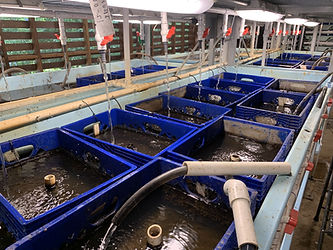
There is also a wet lab that holds three fish quarantine systems (1,000 gallons total); fish are needed to produce mussels, and there are five host fish propagation systems where fish that have been inoculated with mussel larvae are held.
We also have five 100-gallon systems that are for host fish spawning, and the federally endangered Magnificent Ramshorn has its own section in the lab with two 200-gallon recirculating systems.
Outdoor mussel cages for growout
That certainly is a quite impressive network of facilities and systems. Before we go any further, can you tell us about these host fish propagation systems?

So, mussels begin their lives as larvae (parasitic glochidia) and require a fish host to mature into juveniles.
In our lab, we inoculate fish with mussel larvae in order to facilitate the development of young mussels. The host fish provides a place for the larvae to attach, feed, and develop until they are ready to drop off and become independent mussels.
This entire process takes place in what is called an in vivo or host fish propagation system.
Inoculation process
I had no idea that mussels are dependent on fish at the beginning of their lives. Thank you for sharing this with us.
Yes, this is very interesting, and we are glad to share this with you. I want to cover mussel development next.

Freshwater tanks - mussels vs no mussels
As our mussels grow, they are transferred to larger tanks and receive flow-through water from Yates Mill Pond, which supplies food for their growth.
Then we have a large outdoor grow-out area that consists of eight 150-gallon tanks for fish and twelve 8x3’ flat tanks for mussel and snail grow-out. The water for these tanks also comes directly from the pond at Yates Mill.

Juvenile mussel experimental tanks
Our mussels are initially reared in tanks (2.5 gal each) that receive pulsed-flow filtered water daily.
Does all of the water that you use come from the pond that is on the property?
Yes. All the water used at the facility comes from Yates Mill Pond. It is filtered to varying degrees to serve the purposes of the different species in culture. The use of pond water is crucial for mussel culture because ponds provide a lot of food for filter feeders.
Can we actually go and see how this works?

Fresh water mussels cleaning pond water
While we have a classroom that is used for meetings and tour presentations, at the present time, we do not have the resources to accommodate general visits.
Currently, we conduct tours for groups of eight or more people, and these tours can be arranged through the Wake County Historic Yates Mill County Park.
Should demand increase, as our presence becomes better known, we would plan a tour schedule, or perhaps weekly set tours.
We hosted an open house for the public in April and plan to do something similar at least annually.
A 2024 NC State College of Agriculture and Life Sciences article mentions that your laboratory assisted in establishing an imperiled species water quality monitoring network. what can you tell us?
First, I need to tell you that the intent of our water quality monitoring effort is to conduct water quality research and habitat monitoring at sites that will improve the survival, growth, reproduction, and long-term health of mussels and other organisms that are produced at the Yates Mill facility and put back into the wild by North Carolina Wildlife Resources Commission biologists.

At the Yates Mill Aquatic Conservation Laboratory, we help
Collaboration of project partners
accomplish the objectives of our state and federal natural resource management partners by collaborating with them to produce the organisms that they need for reintroduction and to restore priority species native to the Tar and Neuse River Basins of North Carolina.
What about donating or helping support the important work you are doing here?
We certainly appreciate any support that we can get, and there is a donation link on our website (www.yatesmillaquaticconservationcenter.org) which will take you to the NC State University giving site that is linked to our tax deductible foundation account.
Large donors and continuing supporters are needed to help support our operations beyond 2032 when our current funding runs out.. But even small donations help support the work we are doing now.
How would donations typically be used?

A very good question. Financial support helps fund our student interns who provide day-to-day animal and facility care. This, in turn, allows us to train future biologists and also increase the number of species we work with, which increases the total number of animals produced for conservation and restoration purposes.
Donated funds may also be used to improve the visitor experience with video screens or other visuals to help support education and awareness of North Carolina’s rare freshwater species.
Student interns
I want to thank the researchers from NC State for their help in making the Yates facility a reality, and now I want to talk to the NCDOT team here, without their help, this project would not have been possible.
Can you describe the first step in the process that eventually led to the creation of the research facility at Yates Mill Pond?
This process actually began after we received feedback from local communities that they desired improved transportation mobility and reduced traffic congestion on existing roadway networks in an area that would quickly become known as the Complete 540 project.
As part of the Complete 540 project, like any major North Carolina infrastructure project, the NCDOT was required to conduct environmental surveys to assess potential impacts to federally threatened and

Complete 540 Project
endangered species.
What can you tell us about these surveys?
These “species” surveys, were carried out by Three Oaks Engineering, a Durham based company that focuses on services related to infrastructure, transportation, and environmental planning.
Three Oaks‘ surveys concluded that the Complete 540 project “may affect, and is likely to adversely affect” several aquatic threatened and endangered species. These include the Dwarf Wedgemussel, Yellow Lance, Atlantic Pigtoe, and the Neuse River Waterdog.
And what was the eventual outcome?

Renovations at Yates Mill
After that, NCDOT participated in a formal consultation under Section 7 of the Endangered Species Act, and committed to a significant conservation effort to help save the aforementioned species that were named in the Three Oaks Engineering survey.
As part of this commitment, and as discussed in a different part of this Conversation, NCDOT agreed to fund the renovations at Yates Mill, and thus this unprecedented multi-agency partnership was able to be formed.
In your own words, can you describe how this project is just one example of how the NCDOT continues to fulfill this crucial part of its wider mission in our state?
We strongly feel that this collaborative and innovative effort is just one example of how NCDOT can improve the reliability and connectivity of our state’s transportation system, while at the same time demonstrating a strong commitment to environmental stewardship.
Our full support of the conservation of imperiled species through the research and propagation efforts at the Yates Mill facility is again one example of this commitment.
We understand that this was a cooperative effort of the NCDOT, the NC Wildlife Resources Commission, the U.S. Fish and Wildlife Service, Wake County, and NC State University. How was it that all of these agencies were able to get together and contribute to this important project?
The partnership of these five agencies was actually established by Ms. Sarah McRae, a biologist in the Raleigh Ecological Services Field Office of the U.S. Fish and Wildlife Service.
She had for some time seen a need for a facility that could conduct propagation, and research on imperiled aquatic species in eastern North Carolina streams. Sarah worked tirelessly to build this inter-agency partnership. Later she recognized that the Complete I-540 Project Mitigation effort would provide the ideal opportunity to have these agencies work together to research some of these imperiled aquatic species.

Sarah McRae
What can you tell us about this Complete I-540 Project Mitigation effort that appears to be the catalyst for this effort?

I-540 bridge over Swift Creek
This involved significant mitigation efforts to minimize environmental impacts that were the result of the construction of the southern portion of Complete 540 around the Raleigh, NC metropolitan area.
One example was the portion of the highway project that crossed over Swift Creek (Neuse River Basin), which holds three federally listed freshwater mussels, one federally endangered fish species, and one federally threatened salamander.
These efforts included limiting construction activities in sensitive areas like the Swift Creek River Basin, implementing stormwater controls, and managing potential effects on endangered species. Mitigation also addressed impacts to other resources like communication towers, historic resources, and water resources.
I would next like to ask you about some of the agency roles in making the Yates Mill Pond facility a reality. Let’s start with your NCDOT, as many of us may think that the NCDOT just does things like building and improving roads and do not realize that it is also committed to helping sustain and protect endangered species in areas where it is conducting its work.
Yes, the NCDOT would be an excellent place to begin.
Once the decision had been made to have this research facility at Yates Mill Pond, NCDOT provided all of the funds required to oversee design and construction, and in some cases the renovation of the Yates Mill Aquatic Conservation Center.
NCDOT also provided all of the funding for the operation and maintenance of the new facility for the first 10 years of its operation. By being a partner in this facility, NCDOT is meeting its mission by helping conserve threatened and endangered species through research and propagation.
With funding secured, a partnership was formed among the USFWS, NCDOT, the NC Wildlife Resources Commission (NCWRC), Wake County, and NC State University. This collaboration turned the vision into reality.

Renovations to facility
We are certain that the NCDOT agreement to fund this project and its first 10 years of operation were crucial to this project. What other agency contributions would you like to mention?

I think that the role of the North Carolina Wildlife Resources Commission (NCWRC) was interesting and worthy of mention. It agreed to process the necessary funds to ensure that more conservation dollars would go directly to the Yates facility through its agreements with NCDOT and NCSU. This was a monumental step to make the funds go as far as possible and has a significant impact on the protection of the endangered species.
And of course, and as previously mentioned, the U.S. Fish and Wildlife Service (USFWS) was the agency that first conceptualized the idea of a propagation and research facility for the eastern part of North Carolina, and also helped with identifying and securing the most appropriate place to house endangered species propagation and research.
Grand opening of facility
And what about Wake County and NC State University?
Most of us probably by now realize that Historic Yates Mill County Park is in Wake County. The county not only generously provided the land and building, but also oversaw the design, construction, and renovations that were necessary to create the Yates Mill Aquatic Conservation Laboratory.
And the University, in addition to agreeing to operate and maintain the facility, also accepted the responsibility for the research and propagation activities that will hopefully ensure the species’ survival.

Yates Mill County Park
Are there any other examples of NCDOT providing funding or support in other areas of environmental concerns and issues that you can share with us today?
There are too many examples of NCDOT support and funding to mention here and we will talk about just a few that may be of interest to all:

We have a Carbon Reduction Program, which funds projects to cut greenhouse gas emissions.
We have a Wildlife Crossings Pilot Program, which improves wildlife passage by funding fencing and drainage structure upgrades.
Other examples include managing litter through the Adopt-A-Highway program, creating resilience plans to combat climate change impacts like flooding, and implementing public involvement plans to ensure environmental regulations are followed during project development.
Wildlife crossing
How will the results of this research be used to benefit our natural resources and endangered species?
Of course the primary result of the endangered species research at the Yates Mill Aquatic Conservation Laboratory is the successful propagation and eventual recovery of these imperiled aquatic species.
In addition, the findings at this facility will be used to help improve future statewide and regional conservation strategies, habitat restoration projects, and management plans. These include the following:

Establishing a monitoring network: The laboratory is helping to establish an Imperiled Species Water Quality Monitoring Network with partner agencies, which will support long-term water quality measurements in critical habitats to ensure their suitability for species re-introduction and survival.
Educational outreach: The facility, located within Historic Yates Mill County Park, is being used to educate the public, K-12 students, and university students on the value of these organisms and the importance of aquatic conservation, fostering future environmental stewardship.
Monitoring water quality
Guiding development and mitigation: The research is partially funded by a settlement related to a highway project, demonstrating how this scientific data can guide future infrastructure development decisions and ensure effective compensatory mitigation efforts when environmental impacts are unavoidable.
As we draw to a close I want to thank everyone for their efforts. Are there any other initiatives and programs that you want to mention that help the NCDOT address its environmental stewardship & responsibility?
Again, there are too many examples to mention here, but here are a few that may be of interest:

Roadside improvements
Our Roadside Environmental Unit Aesthetics Engineering Section assists in developing harmony between the natural and man-made environments along North Carolina’s roadways. This process involves creating plans for revegetation, reforestation, and site development for rest areas and facilities.
The Vegetation Management Section develops planting programs and maintains roadside vegetation. This includes stabilizing soils, preventing erosion and roadside beautification.
Reduction of Noise Pollution Program. We use the latest state-of-the-art computer models and noise measurement equipment to predict how future traffic noise from road projects might affect an area. And we often implement noise walls and barriers when predicted noise levels exceed existing levels by 10 decibels or more.
I want to thank NC State University and the NC Department of Transportation for taking the time to participate in this conversation. This appears to have been a very well planned and laid out project.
One agency came up with the idea of having a propagation and research facility, one provided the necessary funding, another took responsibility for fund utilization, one provided the necessary land and facilities, and one agreed to operate the facility and its research activities.
And because of this unprecedented partnership, we will be able to protect and sustain several of our state’s endangered aquatic species for generations to come – a job well done by all!
ABOUT THE CAROLINA WETLANDS ASSOCIATION

Carolina Wetlands Association is a 501c(3), non-partisan, science-based organization advocating for wetlands in the Carolinas through educational outreach, grant-funded resiliency projects, and citizen science programming.
Carolina Wetlands works with communities across North and South Carolina to advance flood resiliency through wetland restoration and nature-based solutions. In partnership with landowners, local governments, and conservation organizations, we implement grant-funded projects that restore and protect wetlands that naturally store floodwater, improve water quality, and support wildlife habitat. These efforts strengthen community resilience while helping ensure wetlands continue providing critical benefits for people and ecosystems.
The Volunteer Wetlands Monitoring Program (VWMP) is a core part of our mission to better understand, celebrate, and protect wetlands across the Carolinas. Through this citizen science effort, volunteers collect meaningful data on water levels, water quality, soils, plants, and wildlife, creating information that can inform restoration, management, and future decision-making. The program also gives people a hands-on way to connect with and help care for special places like those recognized through our Wetland Treasures program.
The Wetland Treasures program highlights and celebrates some of the most special and ecologically significant wetlands across the Carolinas. By recognizing these places and sharing their stories, the program helps build appreciation, inspire stewardship, and connect people more deeply to the landscapes that support both communities and wildlife. Together, these efforts reflect Carolina Wetlands’ commitment to protecting wetlands through science, restoration, and public engagement.
Please visit its website at https://www.carolinawetlands.org/ to learn more about the Carolina Wetlands Association and how you can help it achieve its goals.