


Connecting Communities across the Triangle
Now serving more than 232,000 Nextdoor Neighbors in the heart of North Carolina
"BRINGING THE BEST OF NORTH CAROLINA TO YOUR FRONT DOOR"

WHAT’S BEHIND THOSE T.V. WEATHER FORECASTS?

WHAT DOES IT TAKE TO BE A TV WEATHER FORECAST PERSONALITY?
WHAT GOES ON BEHIND THE SCENES TO ENSURE THAT YOU GET THE MOST COMPREHENSIVE AND ACCURATE FORECASTS POSSIBLE,
24 HOURS A DAY – SEVEN DAYS A WEEK?

Matthew Huddleston is a CBS 17 meteorologist covering central North Carolina. He joined CBS in October 2025, and while he serves primarily as the weekend morning meteorologist, he appears in other newscasts throughout the week from time to time. He graduated from NC State University in Raleigh, where he earned his Bachelor’s Degree in Meteorology in 2020. Before arriving in Raleigh, Matthew spent five years in Wilmington, North Carolina, where he earned his National Weather Association Seal of Approval in January 2024. He has tracked dozens of tornadoes, several tropical systems, and even a rare coastal snowstorm during his time in the Port City.

Interviewing Matthew Huddleston today is Bill Riccadonna, the Regency Park Partnership’s community volunteer serving our neighbors in northwest Cary. Bill has been working and living in the Triangle area for over 30 years, and is Broker-In-Charge and owner of Guiding Light Realty in Cary. He is a member of the National Association of Realtors and the North Carolina Association of Realtor. He is an avid outdoor-enthusiast and enjoys many of the parks in the Wake County and Town of Cary park systems. Bill previously participated in our Blue Jay Point Park Conversation that can be seen on our Blog page .
Matthew, thank you for taking the time to discuss weather forecasting with us today.
We all know that accurate and timely weather forecasts are more important than ever, especially with climate change and the perils that come with it, but can we start at the beginning? Looking back, was there a particular time or point in your life when you first realized that you might want to pursue a profession in meteorology?
Bill, I've always loved the weather.
When I was just a little kid, I would watch as many weathercasts on the local TV news as I could. Whether it was stormy or sunny, I didn't care. I just couldn't get enough. That led me to give mock forecasts to my family and eventually sparked the idea that, hey, maybe I could be like one of the meteorologists I saw on TV when I was growing up.
Any particular early weather events that you remember the most and may have helped shape your destiny?

I vividly remember the January 2000 storm with about two feet of snow when I was four years old as being a standout. It was almost to my waist! Later on, I remember being absolutely glued to the TV screen during an April 2011 tornado outbreak.
Tornadic activity
Was there anything in particular from your high school days that later helped you in your pursuit of a career in meteorology?
I took a lot of science and math classes early on, which I felt really helped me in my meteorology classes once I got to college.
You might find it interesting that while still in high school, I participated in a program where I could job-shadow a local meteorologist for a day. That meteorologist was Wes Hohenstein, with whom I now work on the CBS 17 Storm Team. It's funny how life comes full circle.

Matthew Huddleston & Wes Hohenstein
I understand that NC State in Raleigh was your choice for your education in meteorology. Were there any particular reasons for choosing it?
Going to State was a win-win for me.
First, I wanted to stay close to home during college to save money on room and board, and I actually commuted my entire time at college. Second, State had the only meteorology program in the area, one of the best in the state, in my opinion.
Matthew, do you feel that your study of meteorology at the university level prepared you to analyze the data and statistics that are necessary to predict weather conditions after graduation?
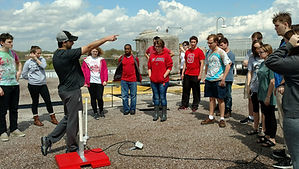
Personally, I actually felt that my studies had more than prepared me to be able to analyze the various data and models that are instrumental in making accurate weather forecasts.
By my senior year, we were all required to do this in class almost every day.
Field class at NC State
That is wonderful to hear. Of course, learning to do an on-the-air TV weather forecast is an entirely different matter, correct?
Yes Bill, it certainly is!
While one may possess the expertise to accurately forecast the weather, broadcasting a forecast to the viewing public in a manner that they will understand and that will allow them to have confidence in the forecaster is certainly a different skill set entirely.
So, were there any specific courses or activities in college that helped you to acquire this skill set?
On the broadcast side of things, there was a broadcast meteorology club I was a part of. It helped me get my feet wet without the intimidation of actually being on-air. This enabled me to practice and hone these essential skills. This part of our education is a lot more difficult than most people realize.
I also took a radar class, which really helped me learn how to read all types of radar imagery. This proved to be invaluable later when I embarked on my career.

Broadcast Meteorology Club
Anything else you want to share in this respect?
You may be interested to know that what really prepared me for my career in forecasting was my internship at WECT in Wilmington. For meteorology students looking to pursue a career in broadcast, an internship at a TV station is a must. You can use it to get real-world experience and can create a weather reel (part of your resume), which you'll need later when applying for a job.
I spent several weeks learning from their meteorologist about how to be a better weather communicator, how to create unique graphics, and how to forecast for a coastal environment. My internship there was cut short due to COVID in 2020, but it was still directly responsible for me getting my first job at WWAY (Wilmington) in July of 2020.
Matthew, how did this work in view of your studies at NC State?

For my internship in Wilmington during my time at NC State, I was able to get my classes scheduled so that I would have to have Friday's off. I would go to classes Mondays through Thursdays, then I traveled down to Wilmington Friday mornings, then spent the night with a relative there, did the morning shift at WECT on Saturdays and then traveled back home.
Meteorology Class
Quite an ambitious schedule, I would think. Was this a paid internship?
No, it was actually an unpaid internship, as so many in the broadcast meteorology field unfortunately are. But I did get college credit for this experience.
You joined the CBS 17 Storm Team in October 2025 and currently serve central North Carolina, including the Raleigh area. Were there any particular or interesting aspects of your previous positions that you want to share with us?
Great question!
I started my career in July of 2020 at WWAY, knowing very little about the broadcast world other than the stuff I picked up at my shortened internship. After some training and getting familiar with their operations, my first position there was as a weekend meteorologist and weekday reporter.
I would give the weather forecast on the weekend and report on general news stories during the week. It was definitely a good learning experience and helped me gain an idea of the geography of the area as I drove around from town to town getting interviews and stories.

On the air
After both an internship and a first full-time job in the Wilmington area, what was it like to return to the Raleigh area?
Growing up in the Raleigh market, I always dreamed of returning here. It took five years, but I was blessed to have an opening come about that I was fortunate enough to receive an offer for. I love coming to work here each day. Every day is different, and I get to talk about something I love. Any chance I get to add in some personality and fun is icing on the cake.
Thank you for sharing this with us. And if you don’t mind me asking, what would you say you like most about your job?

I genuinely like getting to talk about the weather for a living - something I've done ever since I was young. I don’t think that many of us get to do something they've dreamed about since elementary school, and have a job they truly enjoy.
I look forward to coming to work each day. Even when it involves very early alarms. The people I work with are great, and it allows me to be creative with graphics while tapping into my nerdy side, too.
At CBS17 News
How about your least favorite thing about your job?
Easy to answer.
This would be the early hours. I typically do the weekend morning TV weather forecast and get to work at 4:00 a.m. to begin my shift. If I'm filling in on the weekday morning show, it's even earlier, with my arrival at 2:30 a.m. So the lack of sleep at times is definitely my least favorite part of my job. But it's a fine tradeoff for getting to do a job I love.
What about creating the visuals, the weather graphics, and maps that are so important to the public in their understanding of changing weather conditions?
It's more important than ever to create compelling, comprehensive, and entertaining weather graphics. It's our job as broadcast meteorologists to convey the forecast in an easy-to-understand manner. Visual graphics go a long way in helping us do that.
Now the public can easily get the highs, lows, and rain chances on their phones, and we have to make it worth their time and effort for them to take the time to turn on their TV and get the extra level of detail and explanation that a weather app can never give.

Example of visual graphic
Good point! Are there any support personnel who assist both you and the other meteorologists at your station?

No, it's pretty much us all on our own.
From making the forecasts to constructing graphics, and making and deciding what order we want to tell that day's weather story, it is all pretty much up to us. But I like it that way because it gives me complete control over it all. It allows for a streamline approach to the forecast process and on-air presentation.
Forecast Tools
Matthew, what is your job like from a time-management perspective? You may be on the air for just a few minutes at a time, but there may be several hours of preparation time for each of these on-the-air segments.
Time management is extremely important in this job. Things can get hectic, and the TV weather shows, and weather hits wait for no one. If you aren't ready, it starts without you.
That's why I always try to get to the station around two hours before I am scheduled to go on the air, so I will have time to prepare and get everything ready for that day. This includes not only producing forecasts and graphics, but also making sure everything is in order for the start of the weather shows.

Preparing for TV show
Is there such a thing as a standard shift for TV weatherman like you? What about for special and extreme weather situations?

There can often be a nice rhythm for meteorologists. But every day can have a different weather story, so no two days are exactly alike.
There may often be work-schedule adjustments caused by winter storms, severe weather events like thunderstorms and tornadoes, and of course, hurricanes. Those situations can often call for longer hours, as well as high-stress situations where you're juggling several issues at the same time, and little time to catch your breath. But our job is to keep people informed and safe in any kind of weather. So that powers us through.
Hurricane
Are you ever on-call?
We don't have a standard "on call" rotation at our station. Instead, we communicated with each other in advance of major forecasted weather events and decide as a team what the best scheduling options are for each of us.
In some extreme weather events, there may be reporters in the field who are conveying first-hand observations to you. Are these ever useful in fine-tuning or adjusting your forecasts?
Bill, while our reporters in the field can sometimes provide important accounts of a particular weather event, we basically rely on National Weather Service chat rooms for updates on the weather and any storm reports. The NWS and our team typically go hand in hand with the coverage and any forecast adjustments.
I assume that in the field of meteorology and weather forecasting, like many other technical applications, research is helping improve forecasts and developing better tools as well.
Yes, that is certainly true.
Research in this field has really helped us improve our forecasts over the last several decades. What was once purely “now-casting” (the process of using current observations of the atmosphere to generate rapid, short-term predictions) has been replaced by more accurate forecasts of conditions several days in advance of actual events – this is mostly the result of intensive research.
Of course, there are still situations where forecasts don't pan out the way we expected. But all that data goes into research that helps us determine how to be more accurate in the next event.
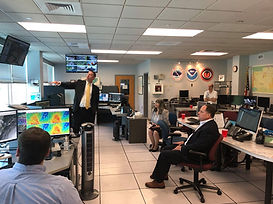
Research in lab
What would you say is the greatest pressure of your job and the major issue that you face?
For me, the biggest "pressure" of my job is making my forecasts as accurate as possible, especially in potential life-altering situations such as tornadoes or hurricanes. I certainly don't want to give people bad advice about how to plan, either hyping up or hyping down an event. That's why our other forecasters and I try to keep things down the middle road and clearly communicate what we know and what we don't know.
What about the general public that you serve? Do they need to be better educated in regard to the data that you broadcast to them?
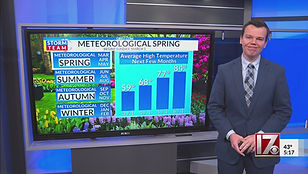
Today, I think anyone, regardless of background and education, can understand the most complex weather phenomena and topics as long as the meteorologist does a good job in their presentation. That's why we aren't afraid to discuss the science behind the weather, not just what's going to happen.
Explaining weather phenomena
Can you give us an example of one major issue that you face today?
I think that the hardest part today has become to not get drowned out by the bad weather information on social media. While there are many accounts on social media with accurate forecast information, there are also others just trying to get people’s attention and clicks for monetization.
Sometimes the most accurate forecast is not the most eye-catching, and we would rather always have the most accurate forecasts, rather than the ones that are most shared on social media.
Yes, social media and even the Internet are certainly challenges that are becoming increasingly an issue. Anything more you want to add before we move on?
The saying has changed from "your competition is the station across the street" to "your competition is the phone or computer in someone's hand". Times have changed to where anyone with an internet connection can also give a weather forecast, even if they're not a meteorologist or a trained forecaster. That's not necessarily a bad thing, but it’s important that people find a source they can trust for accurate information.
In regard to extreme weather, how do TV weather personalities like you try to avoid causing panic while still conveying urgency?
When conveying severe weather projections on TV, it's important to have a “tone” of action but not overreaction. You don't want to make it sound like a severe storm is no big deal, but you also don't want to scream "we're all going to die!" either.
Sometimes we have to calmly guide people through what they are seeing and the best course of action they can take to protect themselves, their family, and their property.
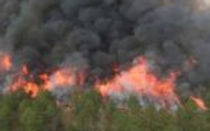
Wildfire
I assume that most TV weather personalities deliver their forecast almost completely unscripted. How does one acquire the skills to do this so that the viewing public understands what you are saying and has confidence in what you are telling them.

Confidence and public speaking are learned skills for the most part, and the longer you are in this career, the better you get. It's very important to be a clear communicator and be confident in what you're saying.
If you aren't confident, the public won't trust what you're saying. And if you aren't a good communicator, they'll find someone else they can understand.
TV weather forecast
Do you and your fellow meteorologists ever visit local schools to teach children about science, and also make public appearances to represent the station?
Yes, we certainly make as many school visits and public appearances as we can.
It's important to inspire the next generation and hopefully spark weather interest for a future meteorologist or two. Public appearances are part of the job, and we all really enjoy them. And it's not always just in a classroom setting. It can also be at career days and other events around the community.
Can you tell us what roles computer models may play vs human judgment based on experience?
Bill, another very good question!
Let me just say that while computer-based weather models may guide our decision making process, the final call is that of the meteorologist. I've heard it said, "Every computer model is wrong, and one needs to decide which is the least-wrong".
And because weather forecasting isn't an exact science, no model and no human can be 100% accurate 100% of the time. We have to rely on experience and past trends to make the call for what we think the future situation will turn out to be. A good forecaster learns from past mistakes and uses these mistakes to improve the next forecast.

Hurricane tracks
What about the use of computer modeling and simulations? Has this changed much in preparing forecasts in recent years?
AI forecast modeling

The biggest change lately has been the introduction of AI models. Like other models, they aren't perfect, but they did a fairly good job of forecasting with the last hurricane season.
I fully expect more improvements in the years to come. However, AI models will likely never be able to get the microscopic details fully figured out. That's what makes weather predicting so interesting.
Tools like Doppler radar, weather balloons, and satellites have been around for a long time now. How useful are these at the present time?
Meteorologists still use all of these tools every single day when preparing a forecast. Radar is more for “now-casting” what you're actually seeing.
Weather balloons and satellites can be used to help predict future outcomes on an hourly or day scale. Without these, we'd be forecasting mostly blind.

Weather Balloon
Matthew, we really appreciate your taking the time from your busy schedule to talk to us today. Do you have any closing words for us before we leave you?

I would just like to say that for anyone looking to get into a career in meteorology, there are a lot of options, and the TV option is still a very important one.
Anyone who has a profound interest in the weather may consider becoming a meteorologist, but this will surely take both hard work and dedication on their part, including the coursework that will be necessary to get a degree in this field.
Giving a TV weather forecast
But those who truly believe they want a career in weather reporting can make it through and chase their dreams. And perhaps the most important and compelling reward for doing so may be the satisfaction they get in knowing that they kept the viewing public informed of upcoming weather events, both big and small.
Matthew, I now have a better understanding of what it takes to be a broadcast meteorologist, and what their daily routines are like. I hope that all of us who depend on TV weather forecasts have learned the same today. Thank you again for your time.